Criminal groups at the service of Iran, the case of the thwarted assassination attempt in Greece
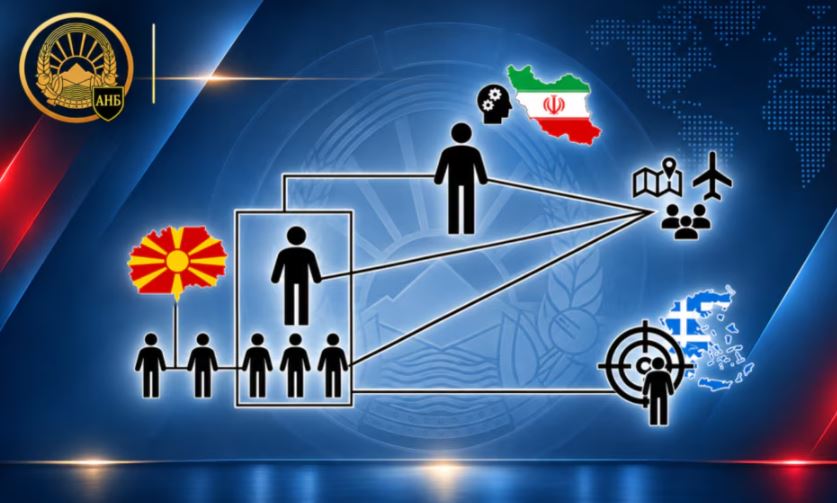
Secret meetings in Iran and other countries, criminal networks, and instructions coming from an Iranian national were part of the preparations for an assassination attempt on a person in Greece, which the security services of North Macedonia and Greece managed to prevent.
The investigations, which lasted about nine months, led to the arrest of five people in November, while another person is still wanted.
At the center of the operation was allegedly Edris Jahangiri Mavaneh, an Iranian national, whom the National Security Agency of North Macedonia (ANB) identified as the main person behind the planned assassination.
The agency suspects that Mavaneh collaborates with Iranian security and intelligence services. It also confirmed his ties to Naji Sharifi Zindashti, an Iranian criminal known for drug trafficking.
What is known about the detainees in North Macedonia and Greece?
At the end of October, a 30-year-old citizen of North Macedonia was detained at the Greek-Turkish border while attempting to enter Turkey. The Greek authorities detained him for security reasons and handed him over to the Macedonian authorities on November 12, reports the Greek newspaper Kathimerini.
His arrest was part of the investigation into the planned assassination in Greece.
According to the Greek newspaper, the target of the assassination was a Greek businessman – whose identity has not been disclosed – of Jewish origin, employed by a company that cooperates with an Israeli state-owned defense company.
North Macedonian agencies have not disclosed who was the target of the preemptive attack.
In addition to him, four other individuals from North Macedonia were also arrested. The security agencies have not disclosed their names, but have stated that they are individuals aged between 29 and 73.
Some details about the operation, as well as photos of the Iranians involved in the network that planned the attack, were published by the security expert from Washington, Adrian Shtuni.
The sixth person is not accessible to the law enforcement authorities and is likely on the run, according to the authorities of North Macedonia.
The police of North Macedonia said that the operation began after the National Security Agency had received information earlier this year through international cooperation regarding six North Macedonian citizens from Skopje and Kumanovo.
During searches at four locations in November, cell phones, computers, USB devices, notebooks with contacts, a sketch with a marked location, as well as weapons and ammunition were found, some of which without the proper permit.
“The network operating in Macedonia consisted of individuals integrated into criminal organizations within the country,” said Bojan Hristovski, Director of the National Security Agency of North Macedonia.
What is known about the Iranians involved in the operation?
Hristovski also mentioned one of the suspected Iranian recruiters, Naji Sharifi Zindashti.
He is an Iranian drug lord and leader of a criminal network that U.S. authorities link to Iran’s Ministry of Intelligence and Security (MOIS).
The U.S. Department of the Treasury says that his network, acting on the orders of the Iranian intelligence service, has been involved in the kidnapping and killing of Iranian dissidents in several countries.
For their role in these activities, the United States and the United Kingdom imposed joint sanctions on Zindasht and his associates in January 2024.
The European Union also imposed sanctions on Zindasht and members of his network in July 2025, describing them as a criminal group linked to the MOIS and responsible for cross-border repression, including assassinations of Iranian dissidents.
Zindashti is also on the list of wanted persons of the U.S. Federal Bureau of Investigation (FBI).
In December 2023, a federal arrest warrant was issued against him for his alleged involvement in a plot to assassinate two Iranian dissidents living in the U.S. state of Maryland.
According to the indictment of the U.S. Attorney’s Office, his network had hired Canadian citizen Damion Patrick John Ryan, a member of the Hells Angels motorcycle gang, for this job.
The U.S. Treasury Department also links Zindasht’s network to the kidnapping of an Iranian dissident in Turkey in 2020.
North Macedonia’s security agencies have not publicly clarified Zindashti’s role in the planned operation in Greece.
Who is Edris Jahangiri Mavaneh?
Unlike Zindashti, there is almost no publicly available information on Edris Jahangiri Mavaneh, whom the authorities of North Macedonia have identified as a key figure in the operation.
His name appeared in the international media only after the Macedonian and Greek services announced that they had uncovered a network that was preparing an assassination.
Greek CNN published his photo and said that he is in Iran, from where, according to this media outlet’s information, he coordinated criminal networks in Europe and America.
According to the allegations, he was responsible for financing, selecting targets, and planning the operations of the attacks, while also having contacts with Turkish criminals.
The Greek newspaper Kathimerini reported that Mavaneh was traveling between Iran and the United Arab Emirates and that some of the suspects had met with him in both countries.
Macedonia’s National Security Agency said there are indications that Mavaneh cooperates with Iranian security and intelligence services.
However, it did not disclose details about his formal position within these structures, nor how he had established connections with criminal groups in North Macedonia.
The U.S. Department of Justice did not respond to Radio Free Europe’s question regarding Mavaneh and his connection to Zindasht, who is wanted. The agencies of North Macedonia are also not sharing any further details.
Warnings from Europe
European security services have been warning for several years about the use of criminal networks in operations linked to Iran.
In 2024, the Swedish Security Service, Säpo, publicly warned that Iran is using criminal networks as intermediaries for violent activities in Sweden and other countries.
Investigations in Sweden and the Netherlands have also shown that assignments can be passed on through several intermediaries, while the people who carry them out on the ground do not need to know who the ultimate client is, as RFE/RL has previously reported.